Monday, 2 April 2018

Aussie Cricket Shame

Last week was a sad week for Australian Cricket, and for Australians in general.  Three cricketers caught red-handed of impropriety, confessed and apologized after being punished by the CA.  My heart went out to all three and the coach as well.

Later, I started wondering what would have happened, if the act was not caught on camera?  Why would the South African Commentator and ex-fast bowler, Fannie de Villers advise the cameramen to track the Aussie bowlers?  Why will we now find out that an Aussie Umpire, Daryl Harper, warned Steve Smith and David Warner, during a Sheffield Shield game of possible ball tampering?  I can only conclude that these two cricketers, Captain and Vice-Captain of the Australian team had been indulging in foul-play and getting away with it.  Why would the two most successful batsmen indulge in this, I wonder!  If they were not caught, then they will continue to do so and have corrupted more youngsters, as in the case of Cameron Bancroft.
  
Australia is a great country to live, and the Australians take pride in fair-play.  But incidents like these make me wonder if it is still the case.  I am aware of many Senior Bureaucrats in Australian Public-Sector organizations rife with nepotism or cronyism.  Most of them get away.  Some get trapped when their excesses are caught on tape, as in the case of a Senior Water Bureaucrat in NSW.  Before he was forced to move-on, he has already corrupted his next-levels of administrators to do his bidding.  It was too late for very qualified and well-meaning staff. The next level administrators are condemned for rest of their career.  No respect from peers, and no self-confidence in their ability to make a sound judgment.

Australians are some of the most fortunate people in the world.  We enjoy a very high standard of living and almost all believe in hard work and fair play.  This culture needs to be preserved.  In the case of the Cricketers, the PM Turnbull has made the correct calls, and the Cricket Australia has acted swiftly.  It's in everyone's interest that all of us are mindful of Aussie ethos, refuse to be corrupted, and blow the whistle when there's a shred of foul play. 

We need not wait to be caught and embarrassed.  

Tuesday, 30 January 2018

The Filipino

“The Filipino is worth dying for”, proclaimed Ninoy Aquino.  And he did die for them.  His killing was one of the most brutal killings of an opposition leader in modern history.  He was shot as he got down on the tarmac, by an assailant supposedly at the behest of the then ruler, Ferdinand Marcos.


An inscription at the Edsa Shrine

Benazir Bhutto, as an opposition leader of Pakistan too, was killed brutally but her death seems to be in vain, considering what has transpired since then.  Ninoy Aquino’s death led to a people’s revolution, a lasting one indeed.  It was very different to the transfer of power, which took place in Zimbabwe, recently, where the military insisted on the transfer of power.  Ninoy’s widow, with the help of the Catholic Clergy, was able to arouse and lead the masses to protest daily, until the then Defence personnel decided to side with the People.  It’s over 30 years since then, and the Philippines have changed Presidents in an orderly manner through elections every six years.


The People Power Monument

So, what was special about the Filipino, Ninoy was willing to sacrifice his life for?  I am not sure.  I have been in the Philippines for two weeks, and my observations are only nascent.  But, they have been very positive.

Metro Manila, a city of 12 million residents and another few million-floating daily, functions in an orderly manner.  The City, at least the part I have been to, is very clean.  There are very little chaos and filth that I saw in South Asian Capitals.  People queue for their turn for everything.  There are queues in supermarkets, bus stops, and even to enter elevators.  There’s no pushing or shoving.  No one tries to jump the queue.  Manila, is a ‘Concrete Jungle’ and green spaces are rare.  But buildings are done in an orderly manner, and there’s sufficient concern for pedestrians.    


A view from a fly-over for pedestrians

I am often reminded of my Filipino colleagues Beth, Fe, Ella, and Jacquie, who supported my work in Oman.  I dealt with a young real estate agent to find an apartment to live, and she was very prompt, and the deal was done very professionally.  People address you as ‘Sir’, in each sentence; even when they do not agree with what you want.  Once, a security guard stopped me entering a car park to cross from one street to other.  He asked me whether I have parked a car, and I answered no.  Then he said, “I can’t let you pass through, SIR”.  Assertive denial, yet with respect. 

I went to the former US Air Base at Clark, which is about two hours from Metro Manila.  Once you leave the metro region, there’s plenty of greenery and agricultural fields.  I was accompanied by three Filipinos, all three were good company.  They explained the history of the Philippines, recent as well as the earlier ones, what they inherited from the Spaniards and the Americans.  They were circumspect about discussing recent politics, and the criticism of human right agencies, which was very understandable.  As we drove, we could witness the impact of the volcanic eruption of Mt Pinatubo, well after 25 years.  The river beds are silver grey, and they shone as the water flew over.  


Glistening River Bed at Clark Air Base

I am told that there are suspended particles from the volcanic eruption in the exosphere and thermosphere, defying gravity, but trapping a range of wavelengths from solar radiation.  They result in spectacular sun rises and the sun sets.


Sunrise from my bedroom: I wake-up to witness a new portrait every morning

The Clark Base is being redeveloped into a Green-City, and my host assured me that they will host the South-East Asia games at the new city in 2019.  That’s not even two years away.  This is in an area, which has not developed and was affected by the Mt. Pinatubo.  But, the Engineer-in-charge was confident that it will be done.  I hope he succeeds, and the sports facilities will be done on time.

I do not want to give a rosy picture of Manila, as I am repeatedly told that the crime in Manila is high.  Bag snatching from pedestrians at gunpoint and pick-pocketing in MRT are too frequent.  The day I arrived in Manila, I used my credit card at the duty-free shop.  My details were stolen, and a total of 1800 AUD was charged to it in two instances fraudulently.  The credit card company has refunded the money, but the card is now canceled.  So, I will take necessary precautions to protect myself, and I will caution you to do the same.

Tuesday, 21 November 2017

Delhi Chalo - Let's Go to Delhi

After 3.5 years, I spent about two weeks in Delhi as a part of an assignment.  Having been a resident of Delhi for two years, and despite mixed feelings about my residence there, I was keen to go back and relive my earlier days.


 Birla Mandir, New Delhi


Travel to India always excites me, but, it starts with a bad taste.  Getting Indian visa is not easy but the Indian visa process has become a lot easier in recent years.  An eVisa can be obtained through an online portal, which is not easy to navigate and crash you out if all instructions are not strictly followed.  There are even stringent restrictions on the size of files to be uploaded.  Once the application is complete – it took me more than two hours, then the eVisa is received via email after three days.  Phew!

I flew to Delhi from Sydney by Air India, which offers a non-stop direct flight of 12 hours.  Air India flies a 787-800 Dreamliner, which is one of the modern aircrafts.  It regulates light and noise to maximise comfort to the passengers.  The airfare was competitive; there’s an excellent choice of movies on-demand, three sumptuous Indian meals in 12 hours, and a generous supply of alcohol.  Some of the electronics of the plane had been tampered with, probably due to ignorance of previous passengers on how to use them.  The flight was exclusively of North Indians, most were Moms and Dads in their sixties, travelling to be with their sons and daughters, who had chosen Australia HOME.  All in all, the flight was very comfortable.  Younger Immigration Officers at Delhi Indira Gandhi Airport are more courteous than their older peers.  Older ones tend to be nosy, or picky, or both.  Despite them, Delhi IGA is one of the modern and efficient airports, I had been through.

My travel to Delhi coincided with me watching a movie, Delhi in a Day (2012), and reading a book titled, White Tiger by Arvind Adiga. 

Delhi in a Day is about Bhatia Family, a middle class - middle aged couple with a grown – unmarried daughter, and her grand-father.  Their lifestyle is supported by seven servants, who also live in the same house.  After being accused of stealing money from an English houseguest, the Bhatia family servants have only 24 hours to replace the cash or face arrest.  But the offender was the grown-up daughter, and the Mother was willing to sacrifice a loyal and old servant to protect the daughter.  The White Tiger is about a Boss and his Driver.  The Driver wants to become a Boss, kills the Boss, run-away to become another Boss, and ends us doing everything that was unacceptable to him when he was a Driver. 

The movie and book follow my imagination of India; there are two Indias - one a rich/educated India of 300 million people, whose lifestyle is supported by the poor/less educated 900 million Indians.  During my travel, intentionally or otherwise, I was looking for evidences to support my imagination and corroborate what I observed in the movie and the book.  It was not difficult.

The Congress Party was in power when I lived in Delhi, and I was curious how things have changed with BJP at the Centre and AAP in charge of Delhi NCR.  There are improvements, the City looked cleaner, and except for fewer instances, the traffic was tolerable.  Still, there’s a long way for Delhi to go to be comparable to modern capitals.  Air pollution, in particular, is atrocious, partly due to geographic factors, but also due to the apathy that exist among Delhiites.  In fact, one of the Indian Novelists, Pankaj Mishra, claims that the successful Delhiites consider that it is their right to litter and pollute the city at their whim, and they take pride in doing so.  I hope he is proven wrong.

The Guesthouse I stayed in was very much like the guest-house in the movie, Delhi in a Day.  A couple, two daughters and a son, supported by about 7 live-in servants.  They rent three of their rooms to guests at a reasonable price, and it’s a good value for money.  Most of the servants are with them for well over twenty years, who serve the family and the Guests who stay there.  The Couple were very welcoming and hospitable.  The servants were very prompt to meet any requests from the Guests.  Fortunately, my experience at the Guesthouse was much better than what happened to the Guest in the movie.

My transport from the Guesthouse to my office was arranged by the Agency I was consulting with.  I was picked-up on time in a Diplomatic Plated car – a real symbol of power in Delhi.  I had none of the power, but my hosts thought that I had.  I did not try to dissuade them.  Usually, the drivers in Asia are very resourceful, but most will offer the information, only when asked.  The driver assigned to me was also very resourceful, and he volunteered information without asking, and I was very happy to receive.  He told me that he ran away from his parents when he was 15.  He is now in his fifties, he is married and his daughter is doing a MS degree.  He spoke about Hinduism at length, and told me about a few cults that I did not know about.  I noticed that he was a voracious reader of internet.  One day, he wanted to talk to me about free-radicals and oxidative-stress.  I quietly listened – I had nothing to add. 

The driver will return me to the Guesthouse after 5 pm, and I had nothing to do till I go to sleep.  The room I stayed did not have a Television, and the Guesthouse had a fixed menu for dinner.  I thought I deserved better in Delhi, and, I sure did make the most of it.

The guesthouse I lived was about 1.5 km from Karol Bagh, a major shopping area in Delhi.  I could easily walk, do some shopping and get some dinner.  I could have a delicious meal for 5 USD or less.  I could have Chicken Biriyani for less than than a dollar.  There are Delhi Styled FOOD-Courts everywhere.  Within a 50 sq m space, food from different states are offered at street corners.  There’s standing space only, and I did not like the way used plates and containers were disposed of.  The food is made in front of you, so, it’s up to you to eat it or not.  I could not resist a south Indian stall, where I had Uthappam and Vada for less than 2 USD.

I also did some Indian dress shopping at Karol Bagh for my wife and daughters.  Another place for cheap-shopping is Paalika Bazar near Rajiv Chowk.  Shop keepers will demand very high prices, but, I had a thumb rule for prices there.  I think of the price in Sydney, divide by three and make a counter offer.  In almost all cases they will agree.  Another place to visit in Delhi is Dilli Haat, where handcrafts and food from various Indian States are on offer.  If you are lucky, you could also attend a regional music concert or a dance programme, there.  I am told that shopping and street food at Chandni Chowk are exceptional, but unfortunately I could not go there.

There were plenty of massage parlours in Delhi, most of them are cover for brothels.  There are exceptions too, and one of them is Pachouli at Rajendra Nagar.  Very modern, reasonably priced (35 USD for one hour oil massage and a steam bath), I really felt refreshing.  After the ‘treatment’, I was offered a cup of tea in their cafe, and witnessed a Senior Staff counselling a young female client on diet and nutrition.  The young women looked rich, modern and pretty.  Still, there was anxiety on her face as she paid attention to the Dietician.  She must have very caring parents who have send her to Pachouli, but, unhappy the way things were to her, I thought.  I wonder what was, or who was bothering her! 

Unfortunately, no sooner I got out of the parlour, my body and mind went back to the conditions, prior to the massage.  Sadly, Delhi’s ambience is so punishing.

I travelled everywhere in Delhi by public transport.  For less than 50 Cents US, I could go anywhere within Delhi in an air-conditioned bus.  They are not particularly comfortable, and every time the bus shifts it gears, it ensures that our bones get a free jolt.  And, after 6 pm or so, these buses are 50% empty.  I practiced my broken Hindi with my fellow passengers or the conductor, who often replied to me in their broken English.


Hindustani Music Concert at IHC


A sitar concert at IHC - The Sitarist deserved better audience!


An Israeli Pianist at IHC - It was almost House Full, and he played non-stop for 90 minutes.

Now to the best part of my stay in Delhi – The India Habitat Centre.  Its website claims, “the INDIA HABITAT CENTRE was conceived to provide a physical environment which would serve as a catalyst for a synergetic relationship between individuals and institutions working in diverse habitat related areas and therefore, maximise their total effectiveness. To facilitate this interaction, the Centre provides a range of facilities”.  So it does.  

My attraction to it was the free movies, concerts, and dance programmes.  There was something that interested me every day.  Within my 13 day stay, I went there five days.   During the period, I was there, the same month India was celebrating its 70th year of Independence, there were a string of movies related to its independence, and socio-cultural issues ensued.  Movies watched were (1) Kushwant Singh’s Train to Pakistan, (2) three short films on Kashmir – Waiting, Rizwaan, and Goodbye, May fly and (3) Shyam Benegal’s Netaji Subhas Chandra Bose.  

All three short movies depicted the suffering of Kashmiris since 1989, when the militancy and army activities started.  There was a discussion among patrons, moderated by a Delhi University Professor soon after the short films.  Unfortunately, the discussion moved away from the artistic nature of movies, to the conflict itself.  Having lived in Pakistan, and listening to the emotional outbursts from both sides, I could not see an end to this conflict.


Chennai Airport Welcomes You.


The Hall with One-Thousand Pillars at Madurai Meenakshi Amman Temple


Sri Ranganatheswarar Temple, Trichy

After two weeks in Delhi, I went to Tamil Nadu for a week.  Despite Tamil being my mother tongue, I am surprised that I am now more comfortable in Delhi, than in Chennai, a city I had been many time since 1980’s.  Delhi has a tendency to engulf you with time.  It is not just its history and its monuments.  It’s the people I meet, the characters in the movie I watched and the book I just read. 

I love Delhi as much as I hate it, and I am sure I will get back there, sooner or later.

Saturday, 1 July 2017

A Farewell Note

As you may all know by now, today is the last day at DPI Water for Prathapar, who managed the Groundwater Modelling team for the last few years, as well as a long history of involvement going back decades working both for us and with us in various roles.

I would like to thank Prathapar on behalf of all of us for his immense contributions to our department, both professional and personal, over that time. His knowledge of hydrogeology and groundwater modelling is of the highest order, and I always knew that when we asked for advice in modelling for Water Resource Plans, State Significant Developments, Salinity Assessments, or anything else that came up, we could have total confidence that we were getting the very best you could ask for.

 And Prathapar could always frame it so you could understand it, whether as a technical peer or to a non-technical audience. Prathapar was a great colleague and mentor to staff he worked with, happy to teach and share knowledge, to "talk science" and to do so in a highly personable manner that made it a pleasure to work with him.

I know that this view is shared with our Water Planners, with the following acknowledgement from Beth Hanson:

"It's a rare skill to be able to translate complex technical information into plain English and adjust it to suit a variety of audiences. Prathapar holds that rare skill. Prathapar designed a session for groundwater planners where he explained how groundwater models are designed conceptually and the scope and limits of their application. This equipped the planners to better communicate with the modelling staff on our working groups, and also provide context to stakeholders in our consultations. 

Prathapar accompanied me along with the hydrogeologists to present to the GVIA on how the Lower Gwydir Groundwater Source had behaved since the water sharing plan commencement and what model updates and calibrations had been made to improve our understanding and better inform decision making. The stakeholders were very impressed and appreciative of his knowledge and willingness to answer their questions to a level of detail that satisfied their interests. 

As a colleague, I can only describe him as a gentleman and a scholar and it has been an absolute pleasure and privilege to work with him."

I can't put it any better than Beth has finished with,.

We wish you all the best in the future and know that you will continue to do well as you deserve to. 

Tuesday, 18 April 2017

Experiencing Discrimination

Discrimination occurs when a person is treated less favourably than others by their race, ethnicity, nationality, disability, age, gender, sexual orientation, marital status, etc.

My hometown Jaffna is rife with discrimination.  An age old caste system discriminates a person based on the family he or she was born into.  A Brahmin’s son is a Brahmin, demands respect and special privileges, irrespective of whether the young Brahmin adheres to conduct worthy of Brahmins.  As a child, I have seen many of lower caste were not allowed into temples in Jaffna, because of their castes.  The caste based discrimination changed gradually, thanks to legislative interventions, enforcement by Police, and the code of conduct demanded by LTTE, which controlled Jaffna for many years.  Some of the progress made in this regard is disappearing, but I am confident that it will not recede to the practices of pre-1960s.

The Government of Sri Lanka instituted statutory forms of discrimination in the 1970s.  Tamils, one of the ethnic communities of Sri Lanka were required to obtain higher University entry scores compared to other two major communities of Sri Lanka.  Sri Lanka paid dearly for this type of discriminatory policies over 30 years, including a loss of over 70,000 lives and migration of over a million Tamils.  The brain, property and productivity losses to the country had been immeasurable.

I am one of those emigrated, first to the USA for higher studies and later to Australia for employment.  As a student in the US, I need not worry about discrimination.  I was better than an average student, won a National Award, scored high GPAs for my MS and Ph.D., and earned a post-doctoral position.  I know I did not experience any form of discrimination and I have many fond memories of my life in the USA for seven years.  Later too, I worked with Americans in Australia, Pakistan and Sri Lanka, some of them were my bosses and the others were colleagues.  Almost without exceptions, none discriminated me because of my origins.

Australia too was very fair to me during my early days.  As an immigrant, I soon realised that I need to produce 120% instead of 100% if I have to make progress, and I did.  The Agency I worked for recognised my productivity and rewarded me regularly until I reached a point at which I sought administrative or leadership positions.  I was not successful twice.  It was then I thought of seeking employment in the international arena.

My first international appointment at UN-Director Level appointment in an International Agency was in Pakistan.  I could swear that I NEVER felt any form of discrimination there.  Despite the prevalence of feudalism, and I being a Hindu in a Muslim country, these differences did not make ANY impact at any level I dealt with.  I recall dining with the President, Governors, Generals, Ministers, Secretaries and Peasants.  Wherever I went, my ethnicity, my religion, my colour of skin, my national origin – none of those were detrimental to me.

My second international appointment was in Oman.  In Oman, Omanis received special privileges not provided to expatriates – but only in very few circumstances, such as highest executive positions in Universities and Ministries.  But at middle and senior level positions that type of discernment was not there.  I moved steadily through ranks and became a senior level administrator.  I was fairly and affectionately treated by my Omani superiors, colleagues, and students for nine years. They were very good days.

My third international appointment was in India; again a UN-Director Level appointment at an International Agency and I never felt discriminated either.  In fact, some of my Indian colleagues would say that there’s no premium for the skin colour, a scorn that was in place for many years, where whites held senior positions in the British Raj, because of their skin colour.

Now I am back in Australia, trying to secure a managerial or leadership position at mid to senior level without any luck.  These positions are at lower levels than those I held in Pakistan, Oman or India at agencies of International stature.  I get rejection letters which contain polite language with zero feedback on why I am not good enough.  They remind me of the rejection letters I had received in Australia before I took on international assignments.

Am I being discriminated because of my age and ethnic origin, I wonder!  A State Government agency in Australia which employs about 350 staff, 20 to 30% of migrants, mostly from Asia, has appointed approximately 30 new Directors and Managers, not a single one has dark skin.  Everyone appointed through external advertisement is a white woman, and every internal candidate got promoted is white.

My reflections are leading to a new hypothesis about discrimination in the Public Sector in Australia.  I am beginning to think that the white Australians can not see coloured skin people as potential managers or leaders, irrespective of their educational background or experience.  Non-Anglo-Saxon names on applications and resumes turn them off straight away.  This invisibility problem may not be there for my kids, who are growing up with white kids, who are seeing them from their childhood.  I wish I am correct.

I think one of the solutions to fight discrimination is to talk/write about it.  Single handedly fighting discrimination and winning is very difficult.  Most of the time, we are discriminated by something much stronger and bigger than us - like a Govt agency.   I was afraid to complain because I feared that I could be punished.  My insecurities and ambitions inhibited me from taking on the big guys.  At younger ages, fighting is even more difficult, because there's always a possibility of being branded as a 'trouble maker', which then affects the rest of the career.  It would have been too hard on us, who grew up with discrimination, trying to establish a new life in a completely new environment and culture.  Now I am about to retire, I feel I should voice it because it may do some good to the next generation, including my kids.  

Will this lead to under productivity at the workplace?  Isn’t this is what the ultimate price of discrimination?  Only time will tell.  I am only hoping that the Australian public sector will wake up soon to the folly they are in.   When almost all Asian countries around Australia are rapidly developing, Australia can ill afford to be colour-blind for long.    

Friday, 27 January 2017

Money & Mani

My nickname is Mani, and it sounds like Money when said in Tamil, my mother tongue.  I was introduced to a five-year-old nephew, who called me Uncle Cash (money of course), Uncle Time (in Tamil Mani is Time), and Uncle Bell (in Tamil, Mani is also a Bell).

My first encounter with Money was when I was a six-year-old, studying year 2.  I found a fifty cents coin on a table at home on my way to school.  I took it and bought candies – I got 100 pieces and generously gave it to everyone in the class.  I became instantly popular among classmates.  When I came home, my mother realized it was me who took the fifty cents, and she beat me till her hand ached.  Ill gotten money brought me popularity and pain almost instantly!  A pretty good lesson for a six-year-old, isn't it?

I do not remember much about having money as a kid, except on Tamil New Year days.  My granddad will give us a red five rupee note each, and that was a big deal, especially when savory snack cost five cents.

But, I do remember very well, not having money as I grew.  My parents struggled to meet day to day expenses, often pawning jewelry, or borrowing money from granddad.  Occasionally they borrowed from neighbors and relatives too.  My parents always paid back whatever they borrowed, but the stigma of being poor was not erasable.  I, the eldest in the family will have to go to the pawn shops or ask someone to lend us money.  I hated it but did it.  There was no choice.  When a National Bank started pawning, I was about 17; I gradually moved all jewelry from private lenders to the bank.  It saved us on interest, and no one in the neighborhood will come to know that we were pawning.

An old Tamil adage says that it is cruel to be poor, worse yet is being poor when young.  I think it is largely true.  When poor, one feels small in front of peers, and angry at times for being unable to change the situation almost immediately.  However, it may also develop a disciplinary attitude to money.  In my case, I learned to live with meager means and did not develop a liking for expensive items.  I am happy to have a decent car, not aspire for a Mercedes.  I am sure this attitude has saved me a lot of money and agony.

In addition to my granddad, a cousin of my dad, a prominent Senator, also helped me generously through my H.Sc. and B.Sc.  Every four months or so, I will go and see him.  He will write a check for my pocket expenses and will say I should repay him when I start to work.  My dues accrued to 7000 Rs.  One day I went to tell him that I was going overseas for my graduate studies and I will settle my dues, once I settle down.  He laughed and said that it was not necessary, wrote another cheque for 1000 Rs, and told me to do well in my studies.  That was the last time I saw him.

The other person, who made me feel rich, was a friend who hired me as a tutor at his Tuition Centre.   He paid me for my work, but also generously paid for my meals whenever we went to cafes and bought clothes, whenever he bought for himself.  I am grateful to my granddad, the Senator and my friend, for making my life financially comfortable, as I grew up.

I started giving private tuitions when I was 17, and the father who hired me as the tutor to his son gave me 20 Rs as the monthly fee.  From then, till now, I am never short of money for my needs.  I think of the father with a lot of gratitude.  He must have meant well.

When I turned 42, I was free of debts of all sorts.  My wife and I had paid for the cars we drove and the house we lived in.  From then on, we made money more than what we had to spend on.  It was then I realized, whether you have money or not, money is a problem.  The surplus income had to be spent judiciously.  We did help out a few who needed financial help, but mostly we saved the surplus for our future.

A friend of mine in the financial sector often teased me, asking what money is.  There are many definitions.  My Father-in-Law told me when he was a student, he had to write an essay on, ‘Money is what it does!'.  His teacher, and probably his teacher's teacher and so on, always knew money is what it does.

At 62, I can relate to this definition very well.  Money provided popularity and pain; facilitated a comfortable education; paid for our family's needs and wants; allowed us to help a few along the way; and now, it provides us with a sense of financial security, that we will be able to meet our needs once we retire!


Thursday, 16 June 2016

Rendezvous in Rajasthan

The Indian State of Rajasthan was the land of Kings.  Being the largest state in India, it is the king of Lands at present.  It was also a part of the Indus Civilization, and most of the state is now desert.  As a kid, I read Tamil monthlies which had many short stories of bravery and romance from Rajasthan.  Emperor Akbar's wife Jodha was from Jaipur of Rajasthan.  Among the kings was my namesake – Maha Rana Pratap, whose name is everywhere in Udaipur.  He kept the Moguls at bay, and finally ended with agreements with them to cohabit.  The state is full of yellowish sandstone forts, distinctively different to the Red Stone forts built by the Moguls across India.  Princess Gayatri Devi, when she got elected to Parliament in the 1970s, she was so elated, she is said to have showered gold coins from a tower in Jaipur.   Rajasthan is also home to Jaipur, widely known as the Pink City with castles all around.  Together, Rajasthan evoked thoughts of bravery, romance in desert kingdoms to me.


The City Palace, Udaipur


The Lake Palace, Udaipur

Between 2012 and 2014, I went to Rajasthan many times, as a part of a project.  It was led by a Rajasthani Australian, and he ensured that the project team experienced Rajasthan’s best.  We stayed in Havelis by lakes, did our touristic duties, and enjoyed Rajasthani hospitality.

 
Night view from a Haveli - Can you spot the full moon?


Witnessing sun rise from a Haveli

Once we went to an unusual hill-top restaurant.  This is in the outskirts of Udaipur; a hill top has been flattened to build a traditional Rajasthani Restaurant.  As we walked there was a mud-veranda, where an old man was doing magic tricks.  Not bad, and I was glad that he did not choke on the metal balls he was spewing out.  Then there was a kid on a balancing rope, with pots stacked on his head, and plates as shoes on a rope about 5 m above ground.  He marched up and down, and came down to collect money.  Then there was a puppet show which was fun to watch.  Finally, two girls danced for Rajasthani songs, not that great but were OK.  Then the food, where in a long hall, we scot and ate a very high cholesterol diet, ghee, butter, sugar, cottage cheese and so on.  Rajasthan is well known for its dairy products.  The best part was that one of the waiters insisted on feeding me!  Don’t get funny ideas – he was a middle aged man.


Rajasthani Dancing

Once I hired an auto-rickshaw in Udaipur.  The driver was so skinny; I could easily see his jaw-bones.  From his appearances, I felt that he must be really poor.  I asked him to take me to a liquor shop and bring me back.  He said it will cost me 40 INR, and I said fine.  After a few minutes, he said he could take me to another one closer to my hotel, and it would cost me 35 INR.  Again I said fine.  When he brought me back I gave him 40 INR, and he was puzzled.  He returned 5 INR, but I insisted that he kept it.  He was a bit reluctant, but took the money with appreciation.  Other big Indian cities would have been different.  Once in Madras an Auto-driver took be a distance of about 5 km, and wanted 1000 INR.  It should not have been more than 50 INR those days.  He started swearing and shouting, and finally settled for 500 INR.  I should have negotiated the fare before I went with him.  I am glad that these petty thieves live only in big cities.


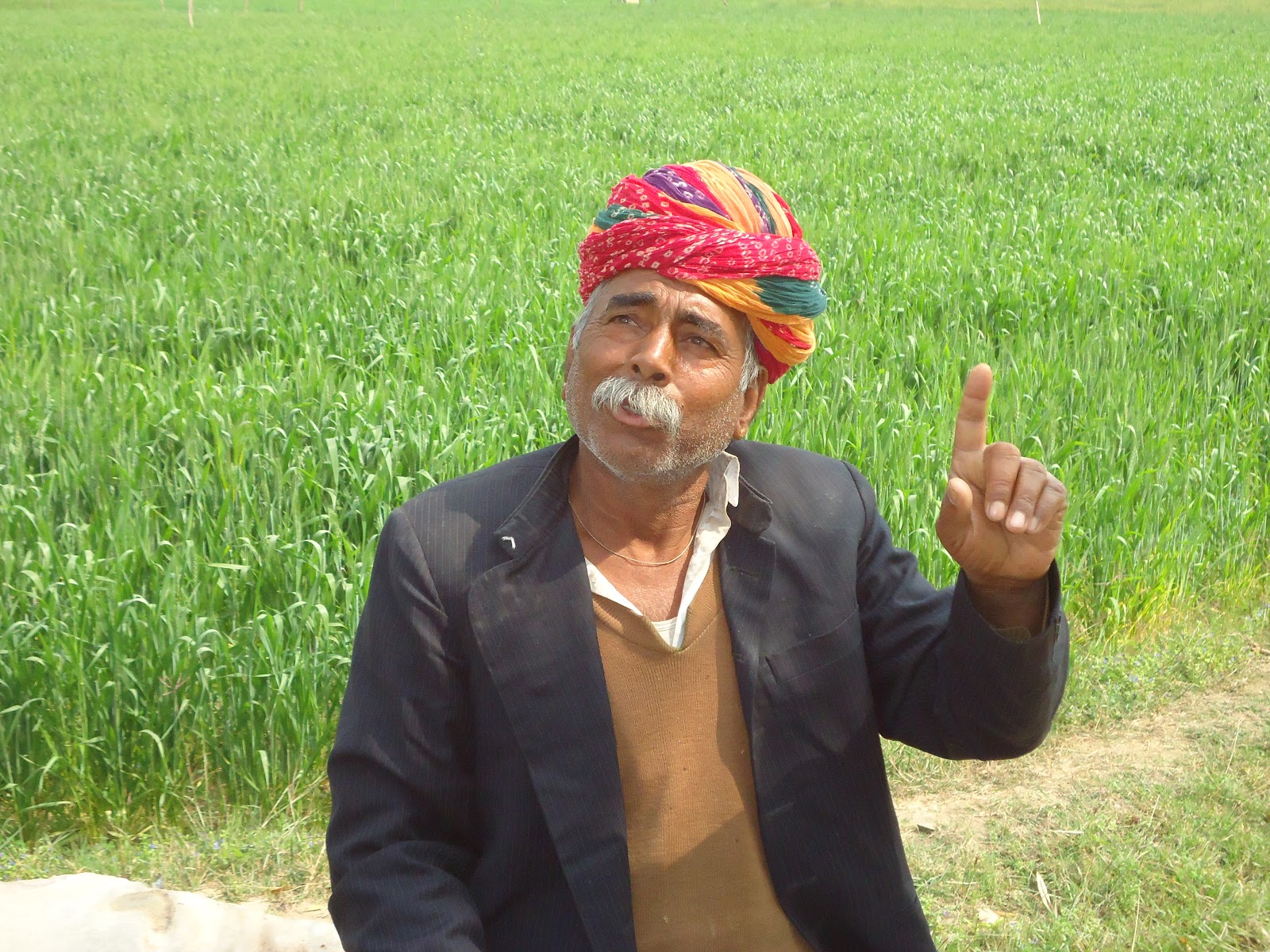
A Rajasthani Farmer

On another occasion, I hired a taxi driver to take me around Udaipur.  He was really dark in color, wore a number of necklaces, some with big pendants, and ear studs with big stones in both ears.  He had an unusual hairstyle including a short pony-tail.  It was so short, you could see only if you pay close attention.  Instead of ribbons or scrunchies as my daughters would wear to hold their hair together, he had a rubber-band holding his hair together at the end of the tail - not at the beginning.  I thought he must have jumped out a cartoon-book.  However, he was very polite, held his arms and hands crossed and head bowed in a subservient manner whenever I spoke, a sight I have seen in old Tamil movies.  There was nothing wrong with his behavior, only my attitude about dress codes and appearances was warped.

I have traveled widely in India, and each state has its own attraction.  But some or other Rajasthan stands out in my mind, may be because it is very different to Tamil Nadu, I am most familiar with.  Udaipur, the city I spent most time in Rajasthan is undoubtedly picturesque and cleaner than most cities in India.

Featured post

Reflections from Cemeteries

During the past two weeks, I was at two Cemeteries, one in Colombo, Sri Lanka and the other in Sydney, Australia.  I probably spent about 9...